There’s a moment coming — maybe sooner than we think — when you’ll stop paying for things. Not because everything is free. Because you delegated payment itself.
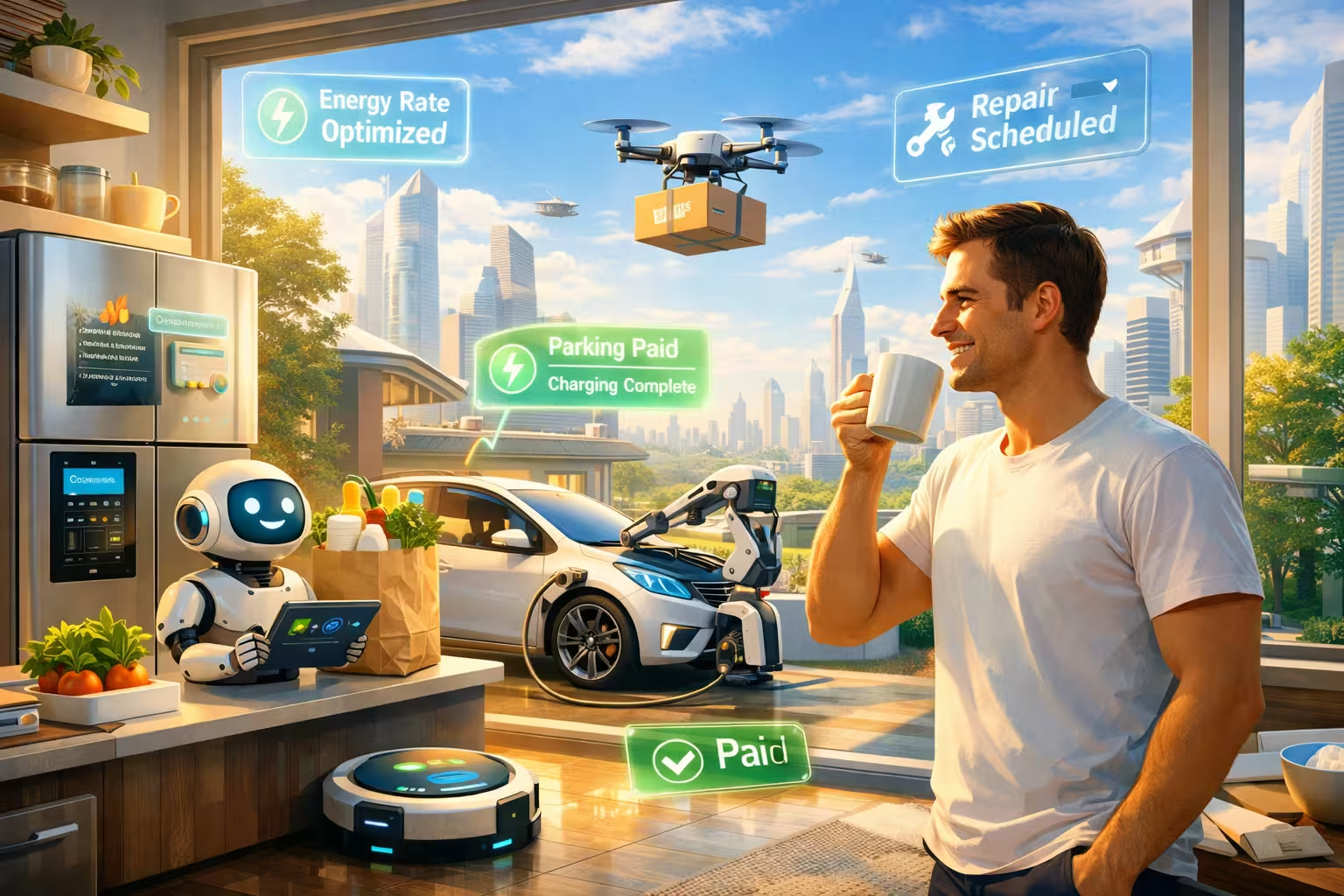
Picture this: It’s 2029. You wake up, and your home has already negotiated last night’s electricity rate with three competing providers. Your car paid for parking, charging, and a 15-minute priority slot at the repair bay for a sensor it noticed was drifting. Your fridge ordered groceries — not from a subscription, but from a real-time auction between four local suppliers. The best price won. The food arrives before lunch.
You didn’t approve any of this. You didn’t even see it happen. Value moved while you slept, in increments too small and too fast for human attention.
This is the economy of agents.
The Problem with Human-Speed Money
Traditional finance was built for humans. We batch payments into paychecks. We schedule bills monthly. We reconcile accounts quarterly. Everything moves at the speed of paperwork because, for centuries, humans were the bottleneck.
But AI doesn’t wait for payday. A machine learning model doesn’t need two weeks to process an invoice. Autonomous agents operate in milliseconds — and they’ll need money that moves just as fast or they simply won’t function competitively.
Elon Musk once suggested that in a world of advanced AI and robotics, humans might not need to work at all. The robots would handle it. But here’s what that vision glosses over: if robots do the work, robots also need to pay for things. They need to buy resources, rent compute, compensate other agents for services rendered. Work without payments is just automation; work with payments is an economy.
Lightning: Money at the Speed of Code
This is where Bitcoin’s Lightning Network becomes inevitable. Not because of ideology. Because of physics.
Lightning settles payments in milliseconds. Fees are fractions of a cent. There’s no bank to approve the transaction, no three-day hold, no frozen account. It’s money that moves at the speed of code — the only speed machines recognize as real-time.
An AI agent doesn’t have a Social Security number. It can’t open a Chase account. It has no credit history, no physical address, no way to satisfy KYC requirements designed for humans with birth certificates.
But it can hold a Lightning wallet. It can generate invoices. It can pay and be paid, instantly, globally, without asking permission.
This isn’t theoretical. It’s already being used in production.
Lightning Enable: The Rails Are Live
Lightning Enable is infrastructure for exactly this future — an open platform that gives AI agents native Lightning and Bitcoin capabilities. Through MCP, REST APIs, and native SDKs, agents get programmatic access to payments, invoices, balance checks, and transaction history. Fully machine-operable.
An agent integrated with Lightning Enable can:
Pay for an API call the moment it’s made
Charge for a service it provides to another agent
Manage its own treasury without human oversight
Earn, save, and spend based on its own logic
No human in the loop. No approval queue. No reconciliation spreadsheet. Just code transacting with code, value moving at the speed of thought.
The Economy Beneath the Economy
Here’s what gets strange: most of this economic activity will be invisible to us.
When your house pays your solar panel’s maintenance drone, you won’t see a line item. When your email assistant tips a spam-filtering agent for catching a phishing attempt, there’s no notification. Millions of micropayments will flow between machines every hour, optimizing, negotiating, settling — and humans will never notice.
We’ll just notice that things work. Quieter. Cheaper. Faster. That costs drift down. That services improve. That the friction of daily life keeps decreasing in ways we can’t quite explain.
The robot economy won’t replace the human economy. It will run underneath it, like plumbing. Essential but invisible.
When Money Becomes Automatic
The end state is strange to imagine: you stop thinking about money. Not because you’re wealthy. Because money becomes infrastructure.
Like electricity. You don’t think about voltage when you flip a light switch. You won’t think about payments when your agents handle every transaction below a threshold you set once and forgot.
“Pay for anything under $50 that I would have approved anyway.”
And then you stop noticing. The lights stay on. The car runs. The food arrives. Agents negotiate, optimize, and settle — endlessly, silently, on your behalf.
You wake up, and everything is handled.
The Trust Problem
Of course, this future requires trust. Trust that your agents act in your interest. Trust that the payment rails can’t be censored or frozen. Trust that no single platform can revoke your agent’s identity — or yours.
This is why decentralization matters. Not as ideology, but as architecture.
An agent economy built on centralized rails is an economy that can be turned off. A payment network controlled by a single company is a single point of failure — and a single point of control.
Lightning, built on Bitcoin, doesn’t have an off switch. No one can freeze an agent’s wallet because they don’t like what it’s buying. No one can deplatform an AI for competing too effectively.
Autonomous agents require autonomous money.
The Future Is Already Here
Every technological revolution feels gradual until it feels sudden.
Right now, developers are already building with Lightning Enable. They’re experimenting. Prototyping. Figuring out what’s possible when agents can transact freely.
Some of those experiments will fail. Some will become infrastructure.
And one day — maybe five years from now, maybe three — you’ll realize you haven’t manually paid a bill in months. Your agents handled it. The money moved while you weren’t looking.
When robots have money, humans stop worrying about it.
Not because the world got simpler.
Because the complexity moved somewhere else.