The web is forking. On one side, the human web we’ve known for decades—browsers, beautiful interfaces, checkout flows designed for people. On the other, an emerging agent web—software that reads, decides, pays, and acts without ever opening a browser.
This isn’t speculation. In the last month alone, Coinbase launched wallets for AI agents. Cloudflare shipped tools to make websites machine-readable. OpenAI published infrastructure for agents to install software and execute code autonomously. Stripe rebuilt its fraud detection from scratch because agent traffic doesn’t move a mouse.
Every major infrastructure company sees it: autonomous agents will become economic actors. They’ll pay for API calls, purchase compute, subscribe to services, and transact with each other at scales humans never could.
But here’s what most businesses aren’t asking: which payment rails should these agents run on?
The answer to that question will shape the next decade of internet commerce. And right now, there’s a land grab underway between two fundamentally different approaches.
The Two Paths
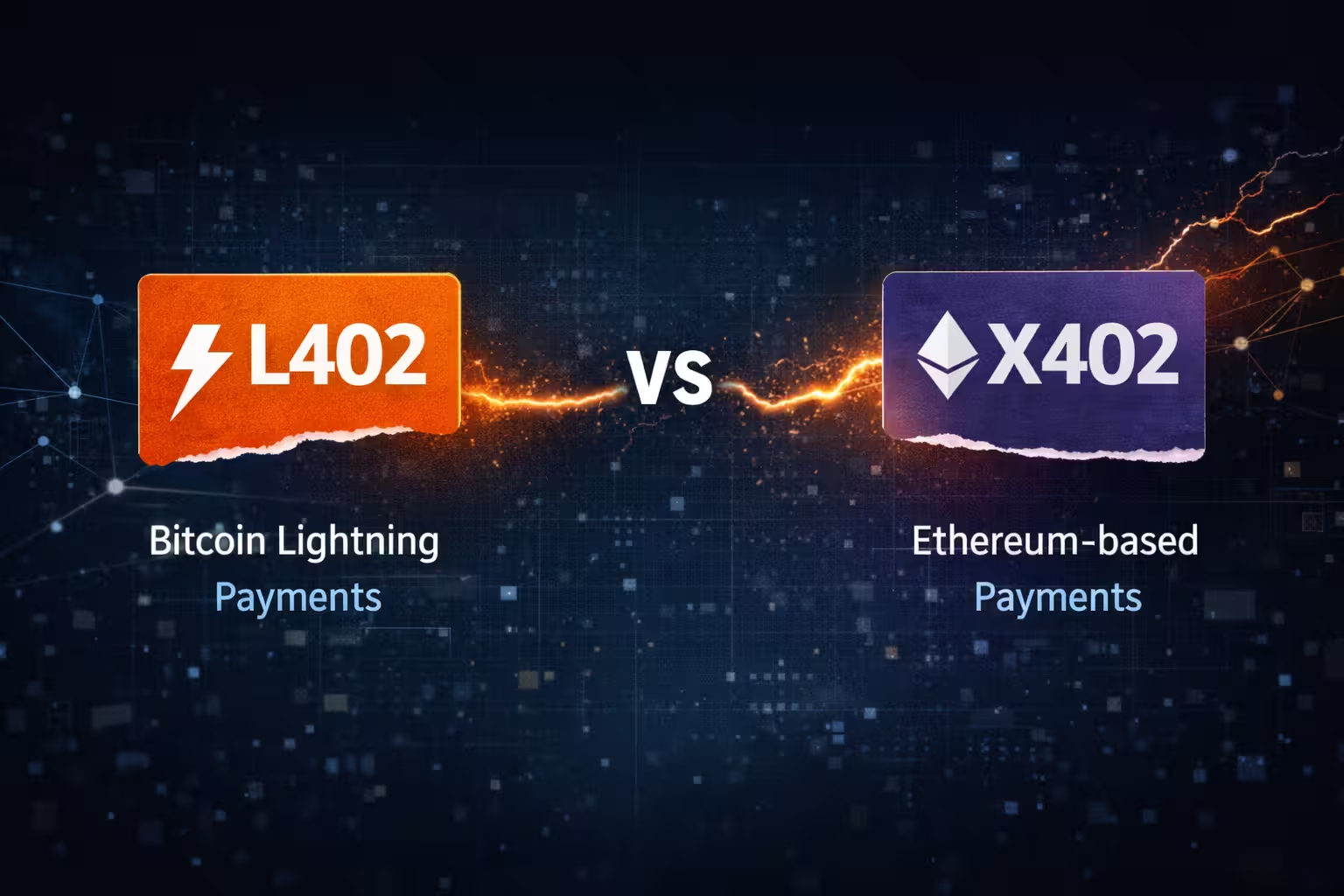
X402 is the Ethereum-based approach, championed by Coinbase and now integrated into Cloudflare. It uses crypto wallets on Ethereum (or its Layer 2, Base) to let agents pay for resources. The marketing is slick. The backers are massive. The headlines write themselves.
L402 is the Bitcoin/Lightning approach. Originally developed by Lightning Labs and now implemented by projects like Lightning Enable, it uses the Lightning Network—Bitcoin’s payment layer—to accomplish the same goal. Less marketing. Fewer headlines. But a fundamentally different technical and philosophical foundation.
If you’re a business deciding which infrastructure to build on, the choice might seem obvious: go with the big names. Cloudflare and Coinbase have reach. They have developer relations teams. They have momentum.
But better marketing doesn’t mean better infrastructure. And for machine-to-machine payments specifically, the differences between these approaches aren’t marginal—they’re structural.
The Technical Reality
Micropayments: Where the Math Gets Brutal
Agent commerce isn’t like human commerce. When a person buys something online, transaction fees of $0.30 + 2.9% are annoying but tolerable. You’re buying a $50 item—who cares about the extra dollar?
Agents operate differently. An agent might make hundreds of API calls per minute, each costing fractions of a cent. An agent browsing the web might pay for dozens of pages per session. An agent managing a portfolio might execute thousands of micro-rebalances daily.
At this scale, transaction costs become the entire margin.
Ethereum’s problem is gas. Even on Layer 2 networks like Base, every transaction requires gas fees. As of February 2026, a simple transfer on Base costs roughly $0.01-0.05 depending on network congestion. That sounds cheap until you multiply it by thousands of transactions per day. An agent making 1,000 API calls daily would spend $10-50 on gas alone—before paying for a single actual service.
Lightning’s model is fundamentally different. Once a payment channel is open, transactions cost fractions of a cent—often less than a satoshi (< $0.0001). An agent on Lightning can make those same 1,000 daily transactions for less than a penny total.
This isn’t a marginal improvement. It’s a 1000x difference in cost structure.
Settlement: Milliseconds vs. Minutes
When an agent pays for an API call, how long until that payment confirms?
On Lightning: milliseconds. The payment is cryptographically final the instant it completes. The API can respond immediately with confidence.
On Ethereum L2s: it’s complicated. The transaction might appear confirmed quickly, but true finality depends on the L2’s architecture. Optimistic rollups have 7-day challenge windows. Even “fast” confirmations carry reorg risk. For high-value transactions, prudent services wait for L1 confirmation—minutes to hours.
For agent commerce, this matters enormously. Agents need to chain actions together rapidly. An agent that has to wait even 10 seconds between payment and response can’t operate at machine speed.
Complexity: One Currency vs. Token Soup
A business integrating L402 deals with one thing: Bitcoin, denominated in satoshis. The smallest unit is fixed. The exchange rate to fiat fluctuates, but the denomination is stable.
A business integrating X402 enters the Ethereum ecosystem’s complexity:
- Which token? ETH? USDC? A chain-specific gas token?
- Which chain? Mainnet? Base? Arbitrum? Optimism?
- How does the agent manage gas? What happens if gas spikes mid-transaction?
- How do you handle token approvals, allowances, and the security implications of each?
- What about bridging between chains when the agent needs to operate cross-platform?
Every additional variable is a failure mode. Every failure mode is a support ticket, a lost transaction, or worse—a security vulnerability.
Contrast this with Lightning Enable’s approach: Get a Strike or OpenNode API key. Configure your endpoint. You’re done. Your API, your URL, your agent—whatever you want to monetize—is now making money. It just works. It’s like magic. It makes you money while you sleep.
No gas management. No token selection. No bridge configuration. No smart contract audits. Just payments, flowing instantly, at virtually zero cost.
This is what we mean by a-commerce—agentic commerce built for the speed of software, not the bureaucracy of traditional finance.
The Ecosystem Question
Technical specifications exist within ecosystems. And ecosystems have cultures, governance structures, and incentives that matter enormously for long-term infrastructure decisions.
Bitcoin: Truly Decentralized
Bitcoin has no CEO. No foundation that can rewrite the rules. No venture investors who need an exit. The protocol changes only through overwhelming consensus among thousands of independent node operators worldwide.
This isn’t a talking point—it’s a structural reality. When you build on Bitcoin, you’re building on infrastructure that cannot be changed at someone’s whim. The rules you’re building against today will be the rules five years from now. That predictability is priceless for infrastructure decisions.
Bitcoin’s development culture is aggressively conservative. Changes are rare, heavily debated, and backward-compatible. The network has operated continuously since 2009 with 99.98% uptime.
The philosophy: do one thing extremely well. Be money. Don’t try to be a world computer.
Ethereum: Captured and Centralized
Ethereum presents itself as decentralized, but the reality is more complicated.
The Ethereum Foundation controls the roadmap. Vitalik Buterin’s opinions move markets and shape protocol decisions. When things go wrong—as they did with The DAO hack—the chain gets rolled back. “Code is law” until the people in charge decide it isn’t.
Consider what this means practically:
- The DAO hack (2016): $60M stolen, chain rolled back by foundation decision, community split into ETH and ETC. The “immutable” ledger was mutated because insiders lost money.
- The Merge (2022): A fundamental change to how the network operates, decided by a small group of core developers.
- Constant EIPs: The protocol changes regularly, sometimes in ways that break existing applications.
This isn’t necessarily bad for experimentation. But it’s terrible for infrastructure you need to rely on for years.
When you build on Ethereum, you’re building on a platform that can and will change based on decisions made by a small group of people. Your smart contracts might work today and break tomorrow because of a protocol upgrade you had no say in.
Coinbase: A Walled Garden
Let’s be direct about what X402 on Base actually means: you’re building inside Coinbase’s walled garden.
Base is Coinbase’s Layer 2. Coinbase controls the sequencer. Coinbase decides the rules. Coinbase can—and does—freeze assets and block addresses when regulators come knocking.
This is the exact opposite of what crypto was supposed to be.
When Coinbase promotes “agentic wallets,” they’re not offering you freedom—they’re offering you a slightly more automated version of the same custodial relationship that traditional finance already provides. Your agents will operate exactly as long as Coinbase permits them to operate.
The entire X402 ecosystem is designed to drive volume through Coinbase-controlled infrastructure. The house always wins.
The Security Reality
Smart contracts are powerful precisely because they’re programs—and programs have bugs.
- Parity wallet bug (2017): $300M frozen permanently
- Various bridge hacks (2022-2024): Billions lost across Wormhole, Ronin, Nomad
- Ongoing exploits: An endless parade of rug pulls, flash loan attacks, and “code is law until we get hacked” moments
When Coinbase offers agentic wallets on Ethereum, they’re offering wallets controlled by smart contracts. Every smart contract is an attack surface. Every attack surface is a liability.
Lightning’s architecture is simpler by design. Payment channels use Bitcoin’s scripting language, which is intentionally limited. The attack surface is smaller because there’s less surface to attack.
Regulatory Clarity
Here’s a question every CFO should ask: how does the SEC view the tokens flowing through your payment system?
Bitcoin has clear regulatory status in the United States: it’s a commodity, regulated by the CFTC. This has been tested in court and affirmed by regulators.
Ethereum’s status remains murky. The SEC has made contradictory statements. Various ETH-based tokens are almost certainly securities. Using ETH for payments means entangling your business with ongoing regulatory uncertainty.
For enterprise adoption, this matters. Legal departments don’t like uncertainty. Compliance teams don’t like explaining to auditors why the company’s payment infrastructure involves maybe-securities on a maybe-regulated network controlled by a maybe-centralized foundation.
The Marketing Problem
Cloudflare and Coinbase have something Lightning doesn’t: marketing budgets, developer advocates, and PR machines.
When Coinbase announces “agentic wallets,” it makes headlines. When Cloudflare adds X402 support, developers hear about it. The narrative forms: this is the standard, this is where the ecosystem is going, this is what serious players use.
But marketing momentum isn’t technical merit. VHS beat Betamax. Internet Explorer dominated browsers for a decade. The best technology doesn’t always win—but it should, and businesses making infrastructure decisions should know the difference.
The companies pushing X402 have incentives beyond building the best payment rails:
- Coinbase profits from transaction fees and wants to drive volume through their L2
- Ethereum ecosystem players benefit from increased ETH utility and token velocity
- VCs who funded Ethereum infrastructure need adoption to realize returns
There’s nothing wrong with having incentives. But businesses should understand them when evaluating “neutral” infrastructure recommendations.
Bitcoin and Lightning have different incentives. There’s no Lightning Labs token capturing value from network growth. There’s no foundation pumping marketing dollars. The incentive is simply: build useful payment infrastructure, get paid for useful payment infrastructure.
What Businesses Should Actually Consider
If you’re building agent-facing infrastructure, here’s the real decision framework:
Choose L402/Lightning if:
- Your use case involves micropayments (sub-dollar transactions at volume)
- You need instant settlement for real-time agent operations
- You want minimal integration complexity (one currency, simple APIs)
- Long-term infrastructure stability matters more than being on the “hot” platform
- Regulatory clarity is important to your compliance team
- You’re optimizing for transaction costs at scale
- You want to own your infrastructure, not rent it from Coinbase
Choose X402/Ethereum if:
- You’re already deeply embedded in the Ethereum ecosystem
- Your agents need to interact with DeFi protocols or NFTs
- Your transaction volumes are low enough that gas costs don’t matter
- You have smart contract expertise in-house
- You’re comfortable with Ethereum’s complexity, governance, and risk profile
- You trust Coinbase to always act in your best interest
The Honest Assessment
For most agent commerce use cases—API payments, content access, compute purchasing, service subscriptions—L402 is the technically superior choice. It’s cheaper, faster, simpler, and built on foundations that won’t shift beneath you.
The only reason to choose X402 is ecosystem lock-in or use cases that specifically require Ethereum’s capabilities (DeFi integration, primarily).
If your agents need to trade on Uniswap, sure, you need Ethereum. If your agents need to pay for API calls at scale, you need Lightning.
Getting Started is Simple
Here’s the difference in practice:
X402/Ethereum setup:
- Choose a chain (Base? Arbitrum? Optimism? Mainnet?)
- Deploy or integrate wallet smart contracts
- Audit those contracts (or pray)
- Set up gas management infrastructure
- Handle token approvals and allowances
- Implement bridge logic if you need cross-chain
- Build monitoring for all of the above
- Hope nothing changes in the next protocol upgrade
L402/Lightning Enable setup:
- Get a Strike or OpenNode API key
- Configure your endpoint
- Start making money
That’s it. Three steps. Your API is monetized. Your content is paywalled. Your agent is earning.
It works while you sleep. No gas to manage. No contracts to audit. No protocol upgrades to fear. Just instant, nearly-free payments flowing directly to you.
This is what the a-commerce manifesto envisions: a world where machines are the customers, and the payment infrastructure gets out of the way. No banks. No approvals. No complexity. Just value moving at the speed of software.
The Path Forward
The agent economy is coming whether we’re ready or not. The question isn’t if machines will transact with machines—it’s how.
Businesses making infrastructure decisions today are choosing the rails their systems will run on for years. Choose based on marketing momentum, and you might find yourself locked into a walled garden that doesn’t scale, costs too much, and can change the rules whenever it’s convenient for the people in charge.
Choose based on technical merit and true decentralization, and you build on foundations designed for exactly the use case you’re solving: fast, cheap, simple payments at machine scale—on infrastructure nobody controls.
The agent web needs payment infrastructure that works like the agents themselves: efficient, tireless, and built for volume. That’s Lightning. That’s L402.
The other path has better marketing. This one has better infrastructure.
Choose accordingly.