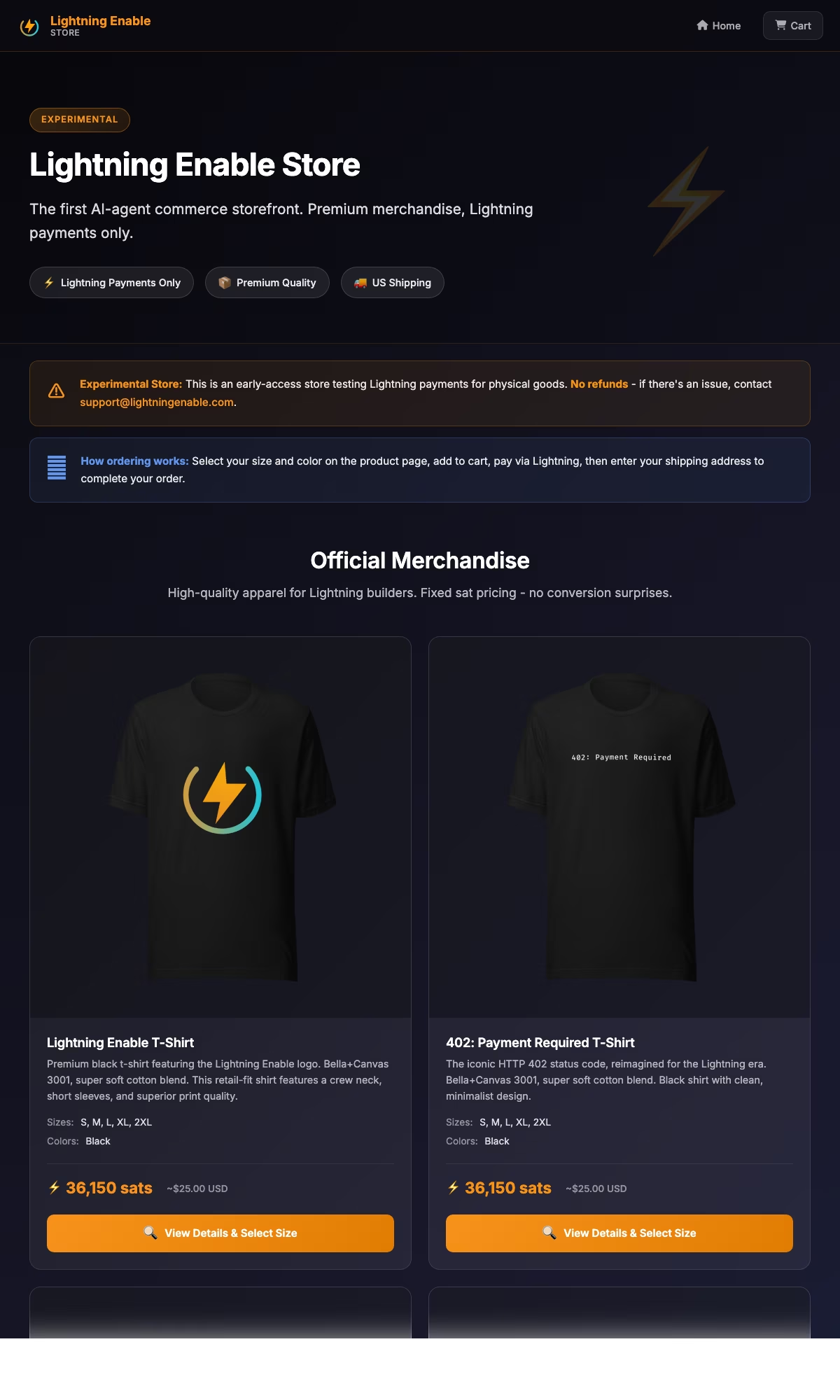
An AI agent just bought a t-shirt. No account. No credit card. No identity verification. It browsed a catalog, paid in sats, and the order went through — the same flow a human would follow, with nothing stripped down or simplified for machines.
The storefront runs on Lightning Enable's L402 implementation, where payment itself acts as authorization. No identity layer required. The sat that moved is the proof.
Watching it happen felt strangely ordinary. The agent chose an item, paid via Lightning, and the order advanced. No checkout forms. No accounts. No CAPTCHA asking it to identify traffic lights.
That's the tell. When something this different feels boring, you're looking at infrastructure that actually works.
At first glance, it looks like any small online store. A handful of products. Prices denominated in sats. Print-on-demand fulfillment behind the scenes. But the interesting part isn't the merchandise — it's what sits underneath: payment as identity, access, and authorization in one.
Humans and agents follow the same flow.
Payment comes first. Fulfillment details come later.
That inversion matters. Traditional commerce asks who you are before asking what you value. It harvests emails, tracks behavior, builds profiles — then maybe lets you buy something. This approach skips the surveillance. Value first. Fulfillment details only when necessary. Nothing collected that doesn't need to exist.
For human buyers, it simplifies checkout. For agents, it opens a path toward real economic participation without accounts, API keys, or pre-negotiated trust.
The storefront is less a destination and more a working example built using L402 Microtransactions — exploring what happens when payments become native to protocols rather than layered on top of them. Visit the store →
From Storefront to Community
Something unexpected happened while building it.
The store worked technically, but it felt incomplete socially.
So the next step was obvious: open it up.
Alongside the core collection, a community-driven catalog began to emerge — designs submitted by anyone willing to participate economically rather than just socially. Submission requires a small Lightning payment, not as a barrier for its own sake but as a signal of intent.
The internet has spent decades trying to filter noise through identity checks and CAPTCHAs. A tiny economic commitment often does the job more effectively.
Every sat generated from community design sales goes directly to OpenSats, supporting the open-source developers who make this ecosystem possible. Designers gain visibility. The underlying infrastructure gains funding. Participation becomes contribution rather than just attention. Submit a design →
Bridging Humans, Agents, and Intent
One of the early questions around agent commerce is practical: agents can pay, but they cannot receive packages.
A simple pattern emerges — agents handle the economic decision, humans complete the physical delivery step. This separation turns out to be powerful. Gifts purchased automatically. Tickets secured by scheduling agents. Services triggered by software but fulfilled by people.
The system doesn’t try to eliminate humans; it coordinates intent between humans and machines.
L402 Beyond Commerce
L402 is often discussed as a way to meter APIs or monetize compute. The community submission flow hints at a broader role: using small economic signals to coordinate participation.
Forms resistant to spam without harvesting personal data.
Content platforms where contribution carries weight without surveillance advertising.
Open ecosystems where participation directly supports the infrastructure itself.
The store becomes a small but tangible demonstration of how payment-native protocols might reshape interaction design.
Bringing It Full Circle
An agent buys a product.
A community designs new ones.
Proceeds fund the developers who keep the system alive.
What started as a technical experiment built on L402 Microtransactions begins to look more like a loop: economic participation replacing performative interaction, payments acting as proof of intent, and agents and humans sharing the same underlying flow.
HTTP 402 waited almost thirty years for a meaningful role. This is one attempt to explore what that role might be — not as a final answer, but as a working example of how commerce, community, and protocol-native payments can converge.
Explore the Lightning Enable Store → store.lightningenable.com
Submit a design to the Community Collection → store.lightningenable.com/store/submit